China’s Energy Transition and Economic Resilience: Dynamic Volatility Spillovers across Green Energy, Crude Oil, and Commodity Markets
DOI:
https://doi.org/10.56868/cesi.v2i1.49Keywords:
Green Energy, Commodity Price Volatility, DCC-GARCH Model, Volatility Connectedness, TVP-VAR, Portfolio DiversificationAbstract
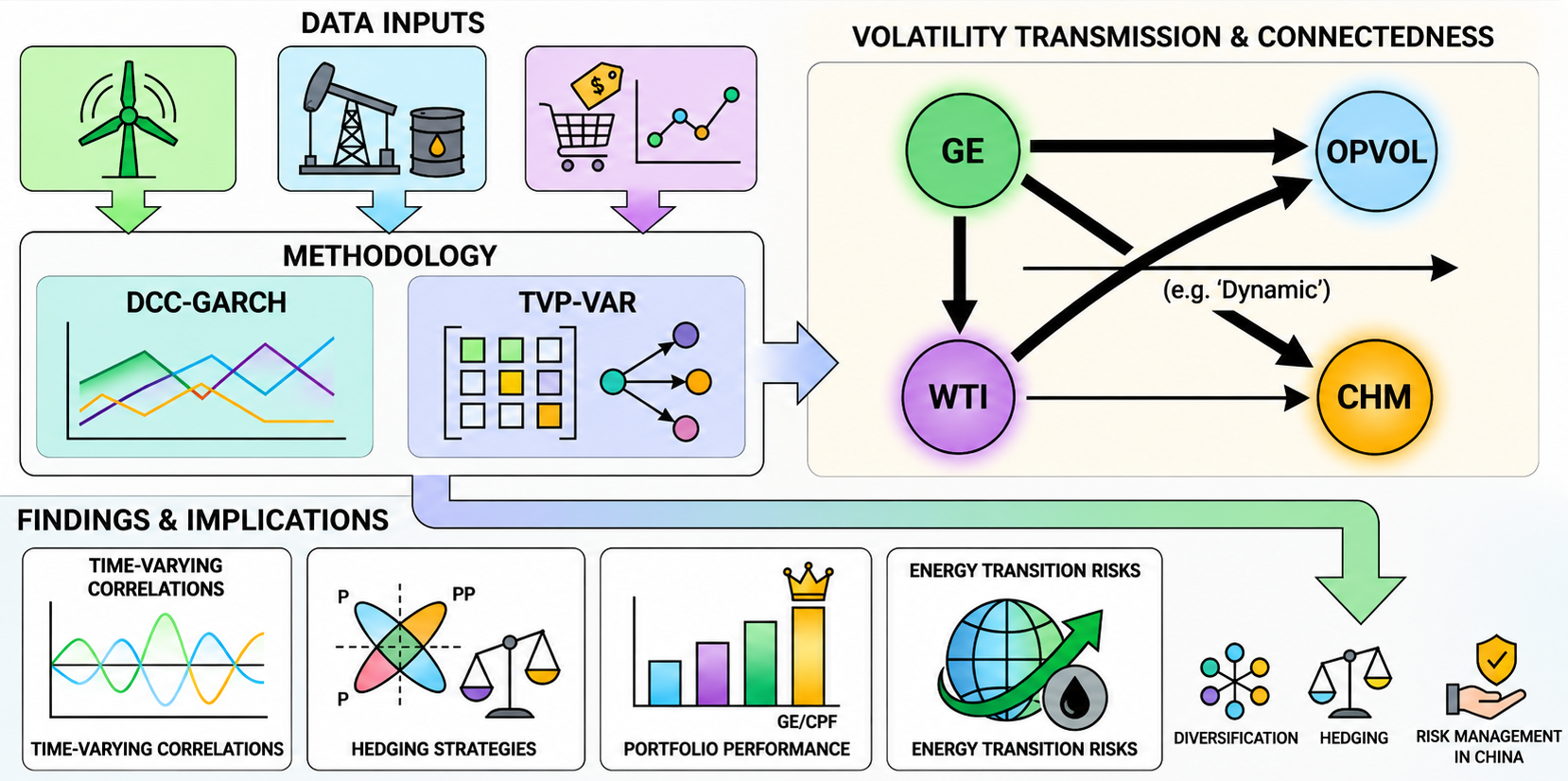
This study examines the dynamic relationships among green energy, crude oil, commodity prices, and the Chinese financial market, with particular attention to volatility connectedness, time-varying correlations, and portfolio risk management. Using daily observations from June 2017 to June 2022, the study applies the Dynamic Conditional Correlation–Generalized Autoregressive Conditional Heteroskedasticity (DCC-GARCH) model together with a Time-Varying Parameter Vector Autoregression (TVP-VAR) connectedness framework. The results reveal substantial but heterogeneous volatility transmission across the selected markets. Green Energy (GE) emerges as the largest net transmitter of volatility, whereas Oil Price Volatility (OPVOL) is the largest net receiver. In contrast, West Texas Intermediate (WTI) crude oil exhibits comparatively limited connectedness with the other market variables. The DCC estimates further demonstrate that conditional correlations vary considerably over time, confirming that market relationships are dynamic rather than constant. Hedge ratios differ substantially across asset combinations, highlighting variations in optimal risk-management positions. Portfolio analysis also indicates heterogeneous risk-adjusted performance, with the GE/CPF combination producing the highest reported risk-adjusted return. Overall, the findings demonstrate the importance of accounting for dynamic energy commodity–financial market linkages when designing diversification and hedging strategies in the context of China’s energy transition.
Downloads
Downloads
Published
Issue
Section
License
Copyright (c) 2025 Climate, Economics & Social Impact

This work is licensed under a Creative Commons Attribution 4.0 International License.